Research at the edgeof the known

Mercury is the AI scientist from Event Horizon Labs. It reads the literature, forms hypotheses, runs the experiments and writes up what it finds.

Fig. 1 — a black hole, ray-traced live in your browserObserver at 24.0 rsPast the event horizon

Scroll to cross the horizon

Mercury

It reads. It reasons. It hypothesizes. It experiments. Every source, plot and line of code stays in view, so you can check the work.

ReadsReasonsHypothesizesExperimentsyour question
Fig. 2 — A Kepler orbit with Mercury’s eccentricity (0.206), its precession exaggerated. Every Lab circles one question.

What is Mercury?

An AI scientistwith a Lab of its own

Give it a research question. It searches the literature and scientific databases, writes and runs the code, and writes up what it finds. Every source, file and run stays in the Lab, so you can retrace each step.

Literature
arXiv, PubMed, bioRxiv, medRxiv, Semantic Scholar, OpenAlex and Crossref.
Databases
36 across proteins, genomics, omics, pathways and chemistry, from UniProt, the PDB and Ensembl to GEO and ChEMBL.
Where it runs
Cloud Labs right in your browser. Local Labs in your own folders with the desktop app, where it can run code. Remote Labs on a server over SSH.
What it may do
You choose: Auto, Ask, Accept edits, Plan or Full access. Spending on a GPU always asks first, unless you allow it.

Inside a Lab

Four moments from real Mercury Labs, shown exactly as they ran.

It reads the literature

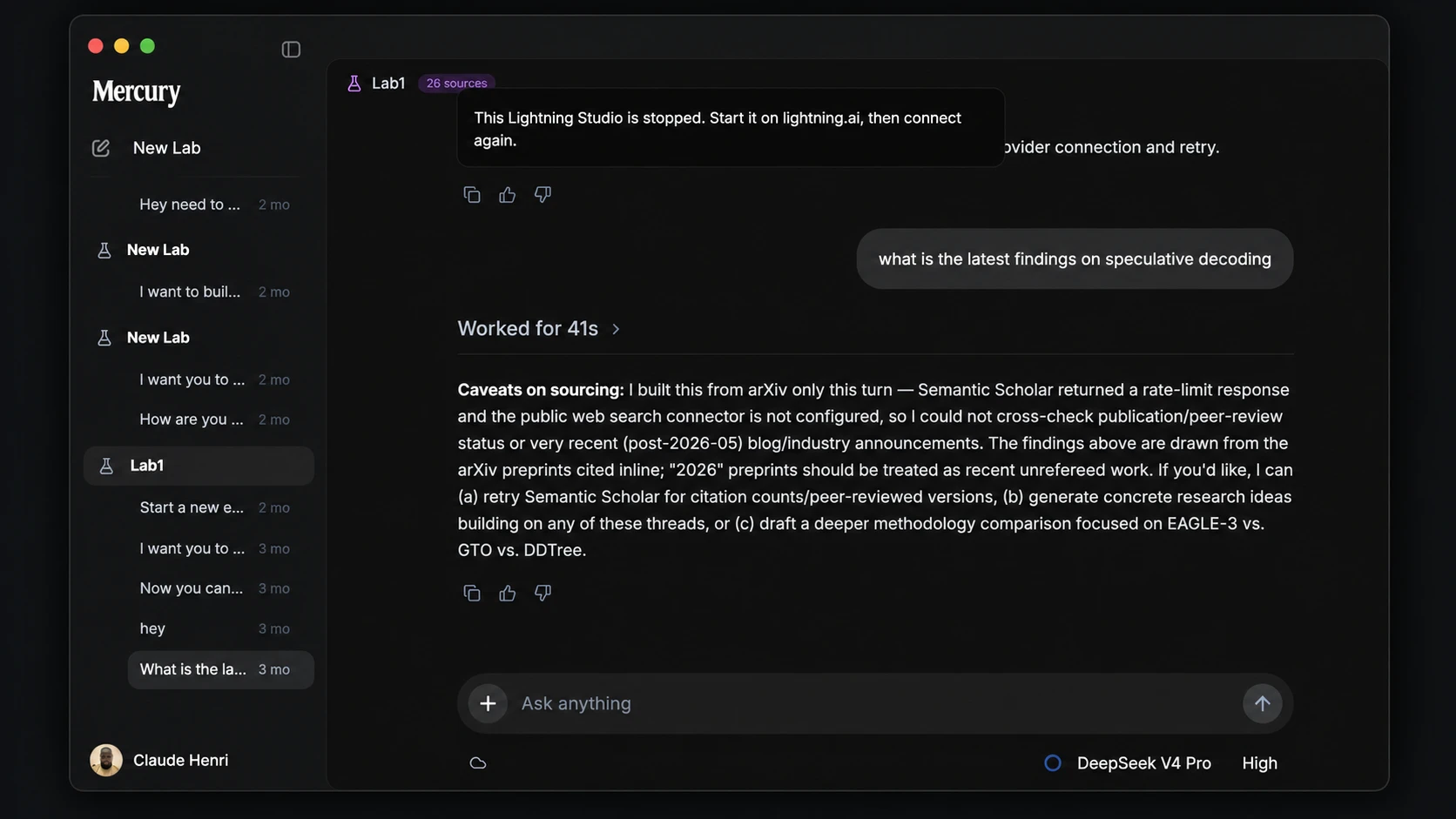
Asked for the latest findings on speculative decoding, Mercury worked for 41 seconds and cited the arXiv preprints it used inline. Then it said plainly what it couldn't check, and offered three ways to go further.
Lab1 · 26 sources · DeepSeek V4 Pro

Mercury's answer to “what is the latest findings on speculative decoding”: after 41 seconds of work, a “Caveats on sourcing” note explains it used arXiv only because Semantic Scholar was rate-limited, flags 2026 preprints as unrefereed, and offers three next steps.

It checks its own work

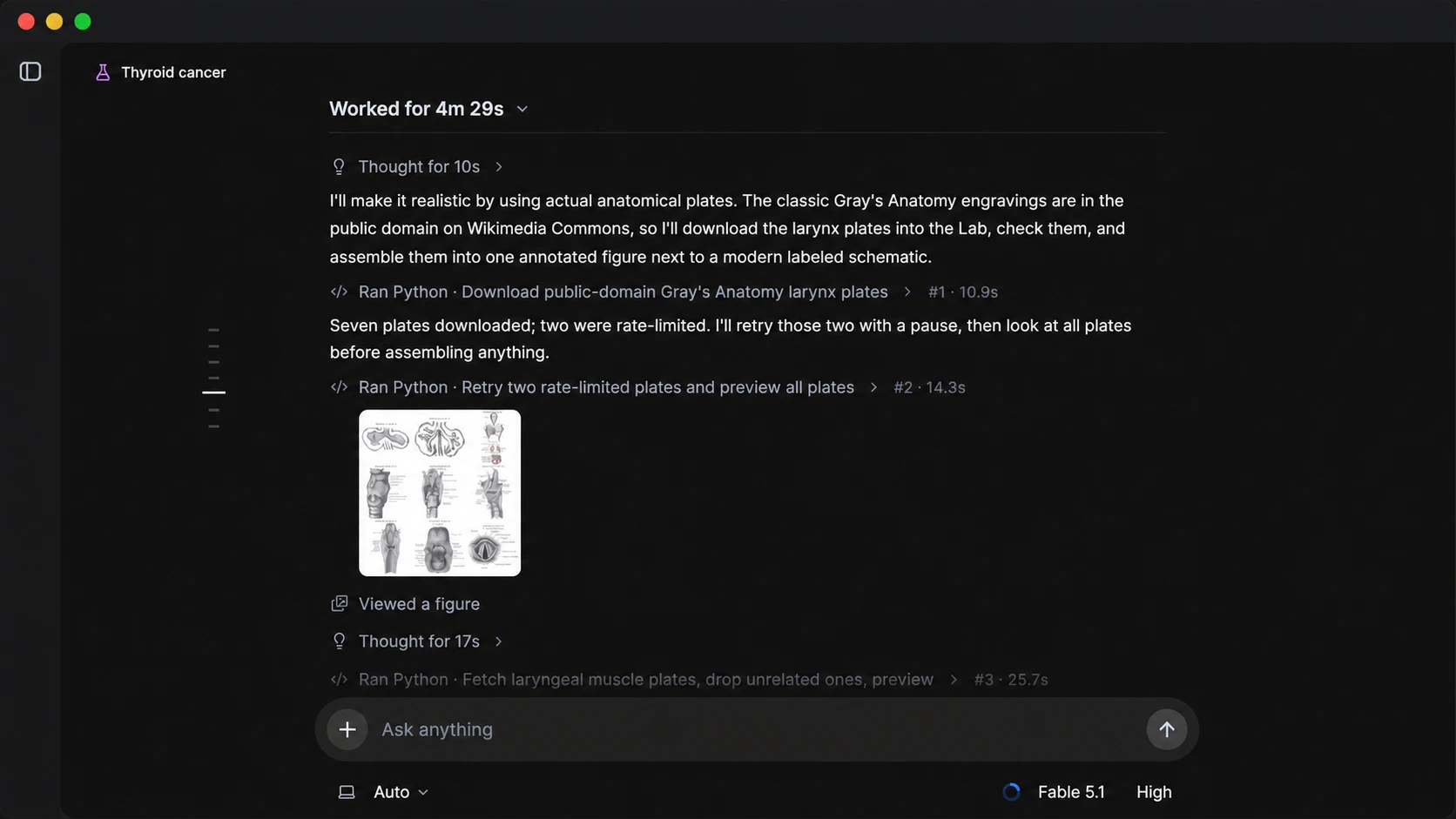
To build an anatomical figure, it chose public-domain Gray's Anatomy plates and downloaded them with Python. Two downloads were rate-limited, so it retried them after a pause, and looked at every plate before assembling anything.
Thyroid cancer · worked for 4m 29s · Fable 5.1

A Mercury run in the Thyroid cancer Lab: it plans to use Gray's Anatomy larynx plates from Wikimedia Commons, runs Python to download them, retries two rate-limited plates, previews them as a figure and views it before continuing.

It proposes the next step

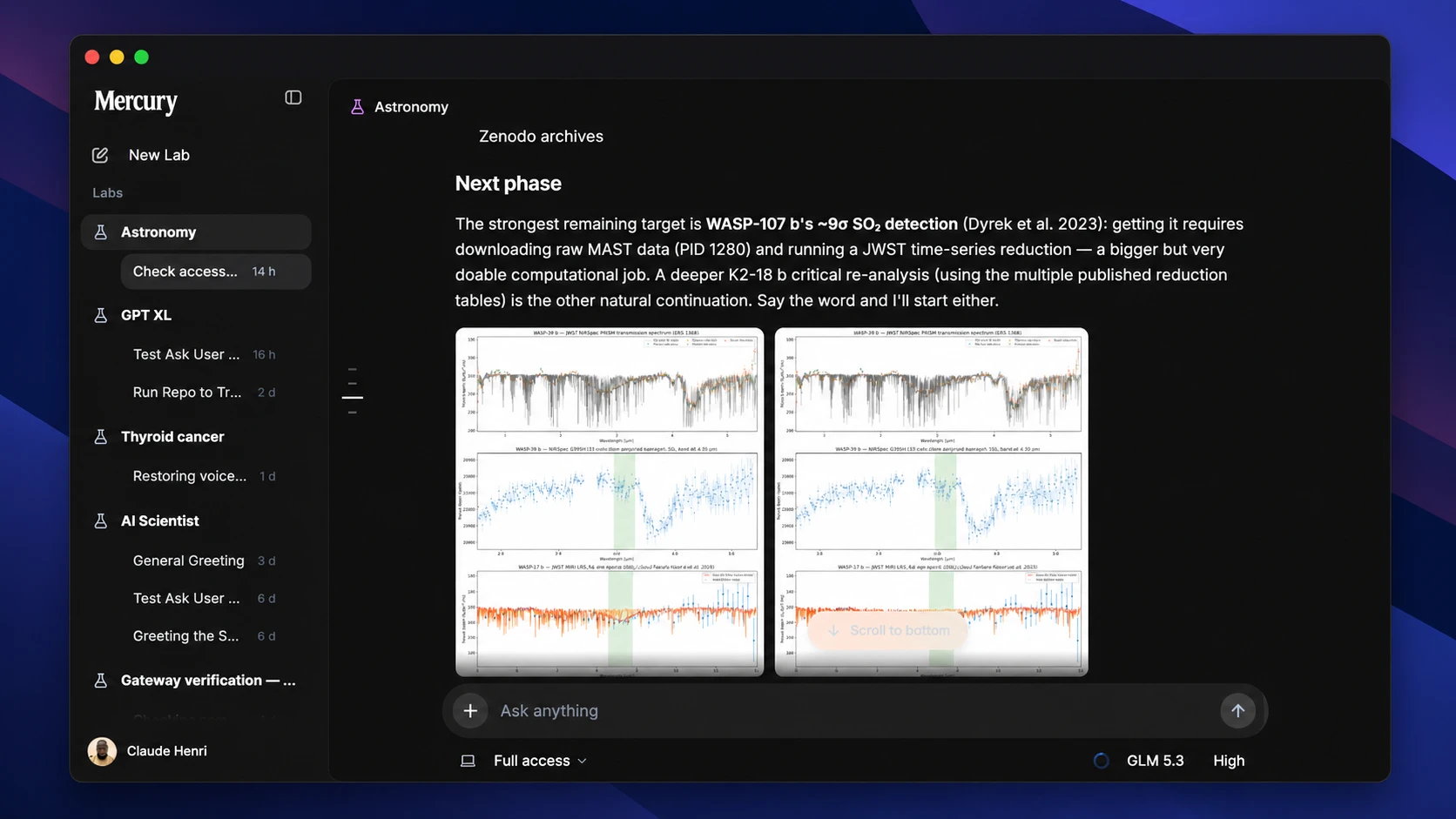
After plotting JWST spectra of WASP-39 b and WASP-17 b, it names the strongest target left, WASP-107 b's SO₂ detection, says what it would take (raw MAST data and a JWST time-series reduction), and waits for your go.
Astronomy · GLM 5.3

Mercury in the Astronomy Lab proposing a next phase, WASP-107 b's SO₂ detection from raw MAST data, beside its plots of JWST transmission spectra for WASP-39 b and WASP-17 b.

It writes and runs code

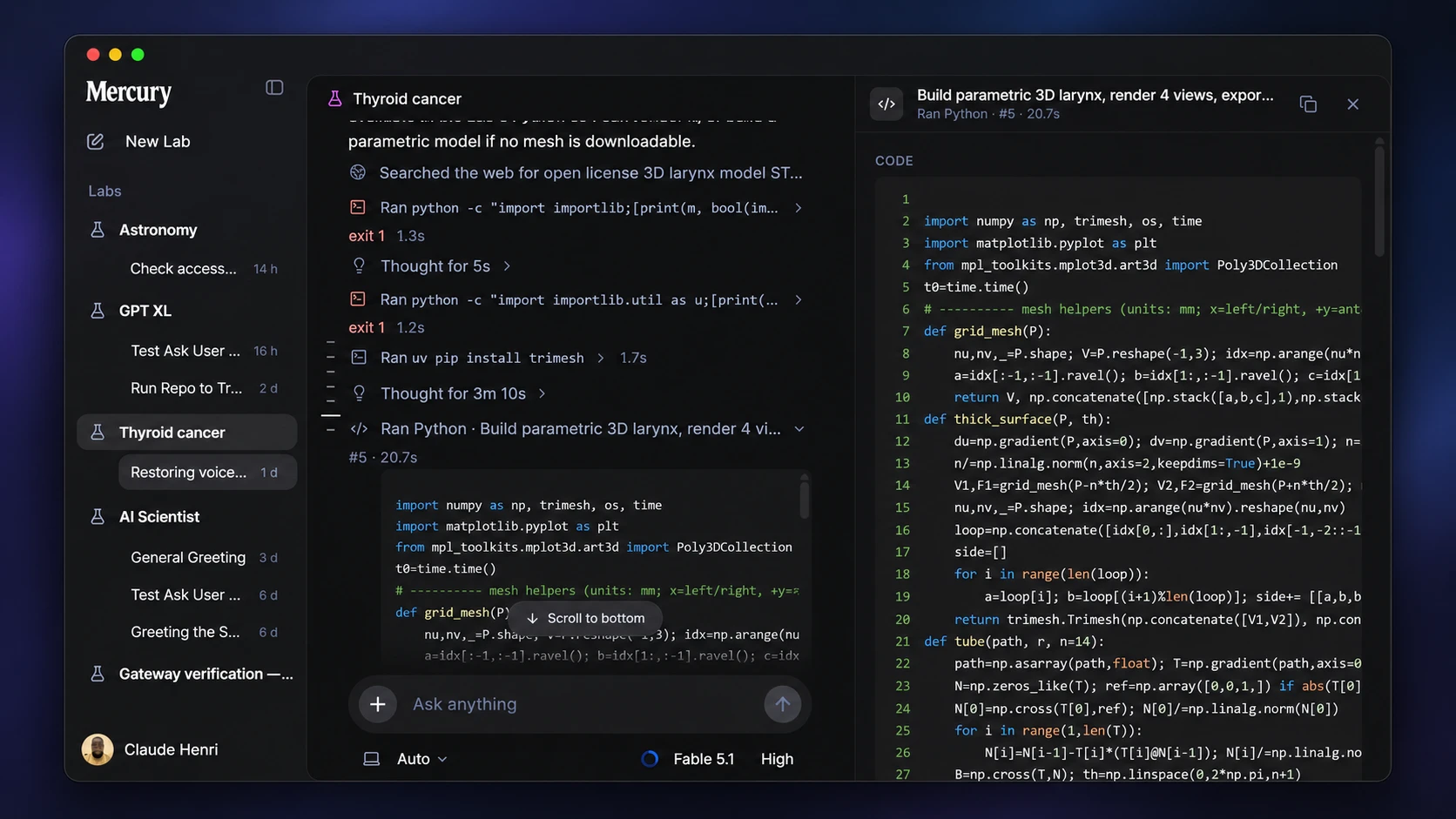
It searched the web for an open-license 3D larynx model, ready to build a parametric one instead. Failed checks show their exit code; it installed trimesh, then wrote the script that builds the model and renders four views. Every run opens beside the chat, code and all.
Thyroid cancer · run #5 · 20.7s · Fable 5.1

Mercury's run list in the Thyroid cancer Lab: a web search for an open-license 3D larynx model, two Python checks that exited with code 1, “uv pip install trimesh”, and a Python run that builds a parametric 3D larynx, with its full code open in a side panel.